

When Pittsburgh started direct flights to Iceland in 2017, everybody and their brother went to Iceland. Stop a Pittsburgher in the street and if they haven’t been to Iceland, they know someone who has or they’re planning to go.
Average traveling Americans typically won’t go through the hassle or have the vacation time for multiple long legs, tiring lengthy layovers, and complicated flight planning – all but certain for the most exotic world travel. They want EASY and QUICK.
So, we invaded Iceland and have made it crowded and touristy in the process, and now its neighbor Greenland is in our direct-flight crosshairs – God bless them. A cadre of journalists arrived during our July visit, guaranteed to further drive American tourism.
We eventually would have toured Greenland regardless, but the new direct United Airlines flight from Newark, N.J., saved us practically a day of travel to reach it. As soon as we learned of the flight, Greenland shot up our travel list and we went within its first two weeks to potentially miss what has befallen Iceland.
For perspective, in 2024 Iceland had 2.26 million tourists, nearly doubled since 2015. Greenland had 150,000 tourists in 2024. Greenland, the world’s largest island, is 21 times the size of Iceland.
We found the few hotels Greenland offers were near full capacity, and when inclement weather delayed plans – which is often – Greenlanders offered up rooms in their own homes or bunks in a school.


Clockwise from top left, Colonial Harbor in Nuuk; Some of the wooden kit homes provided by Denmark starting in the 1700s; cemeteries with primarily white wooden crosses and very few engraved stones. The graves ripple the land, as the permafrost only permits shallow digging. Rocks then cover the deceased’s remains, and soil is deposited on top. A number of graves are dug in the summer to prepare for those who pass during the rest of the year.
It’s hard to believe increasing tourists won’t drive further development, and I worry about how that will affect the still raw, wild and beautiful landscape. Modern high-rise hotels would spoil the panorama; crowds would spoil the quiet and trample trails.
Their quiet, untouched landscape is Greenlanders’ pride and joy and they want to show it off. But they’re very communicative about how climate change is mutating it, causing dramatically increasing ice melting and glacier calving, and negatively impacting their lives. It’s now common to see a lot of standing water, mud, and streams where they never existed before a few years ago, locals said.


A sculpture of Sedna, the Mother of the Sea, overlooks Nuuk’s Colonial Harbor. One of the most important figures in Inuit mythology, the powerful sea goddess rules over the marine animals that Inuit people depend on for survival, and angrily withholds her bounty when humans disrespect nature. Many young Inuit women, including our guide, are tattooing lines across their fingers to illustrate where Sedna’s mortal fingers were cut off as she was cast into the sea as punishment. The myth goes that her fingers became the sea’s creatures, and young Inuits see the tattoos as a reminder to respect climate change.
The few vehicles here are mostly electric – with power outlets provided by workplaces. The cost of fuel and fuel-powered vehicles is exorbitant on purpose. And diesel, imported from Venezuela to heat their homes, is making way for new hydropower plants. They want to be as green as hydro-powered Bhutan, we were told.
(Bhutan, by the way, is the epitomy of green. When we visited in 2018, it used a “high-value, low-impact” tourism plan to limit environmental impacts and to encourage sustainability. It capped tourist numbers; charged a $200/night visa; and required a constant personal guide. It’s not for the budget traveler – on purpose. Bhutan is pristine. Perhaps Greenland will consider these Bhutanese ideals as well, hopefully before it’s too late.)
The Greenlandic Inuits – who make up the vast majority of Greenlanders – we encountered had a mixed view of coming changes. Discovering we were American, some were openly unfriendly while chatting happily with other foreign tourists, most coming in for short visits via cruise ships; some were openly curious to meet us in the flesh.
Overall, however, the Greenlanders were polite and accommodating, though I sensed their apprehension.
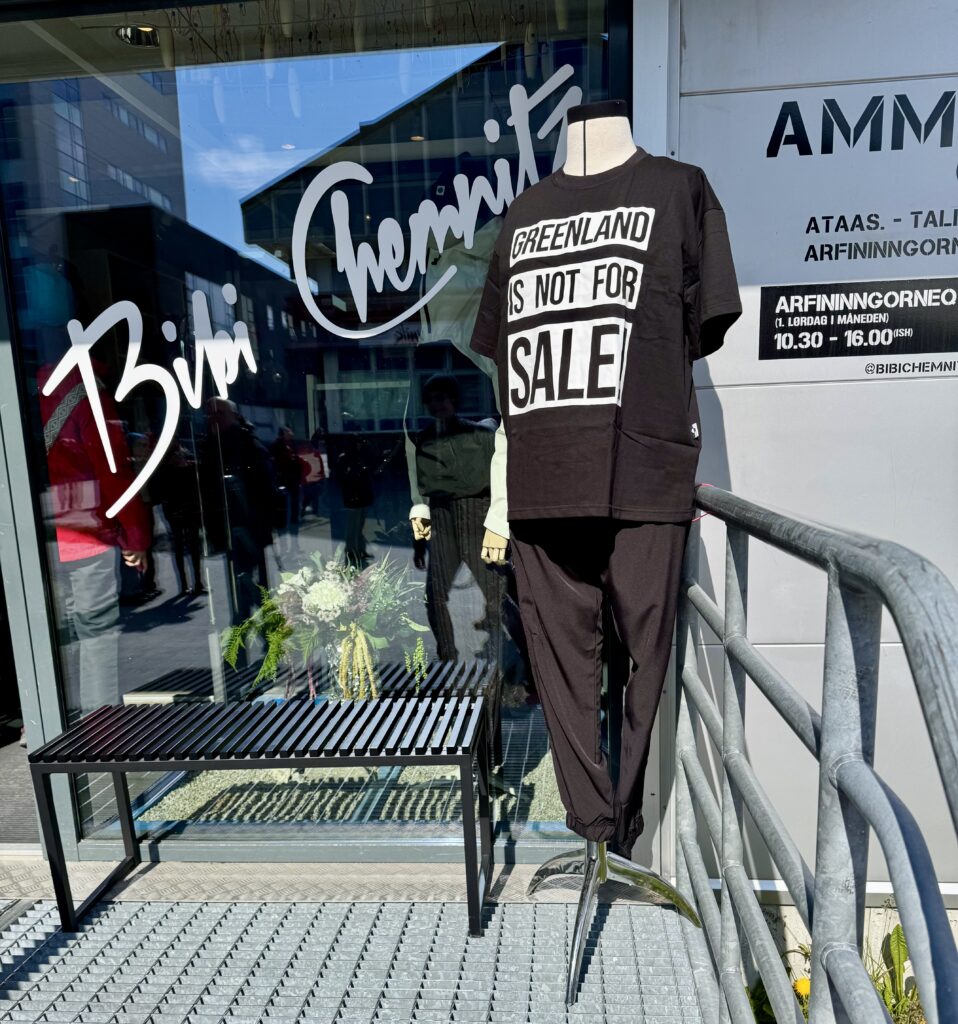
That apprehension is twofold: what will we do to their vast natural landscape; and what the hell does our president think he’s doing? “Greenland Is Not For Sale” read t-shirts and hoodies in a store window.
It certainly is not, but President Donald Trump also has threatened annexation by force. (The Associated Press reported that Denmark is actively investigating Trump-sent influencers allegedly collecting names of those who oppose Trump and collecting information to influence Greenlanders to turn against Denmark.)
It’s difficult to put into words how offensive that is, until maybe you encounter an Inuit Greenlander whose family has fished and hunted this harsh land for centuries (their top economy), understand their collective community culture (no one owns land), the brutal weather they heartily endure, and the immense pride they have – and should have – in it all. They’re not for sale.
This is their ancestral home, and their outlook must echo the native Americans as they were run down by our own colonists.
When the French president visited in June, he described the U.S. threat to Greenland as a warning for all of Europe that America will not respect autonomy.
“The situation in Greenland is clearly a wake-up call for all Europeans,” Emmanuel Macron told Danish and Greenlandic leaders.


Inuit dancers in traditional garb, renowned for its beadwork, in a small remote village had just finished performing at a church service; two of our Inuit guides, brother and sister, with their mother. They are very vocal about preserving their country.
Debate over the geopolitical argument Trump uses is absurd in Greenland. The U.S. enjoys primacy with long-standing ally Denmark, which allows the U.S. to own Pituffik Space Base in the northwest. The base is strategically important for missile warning, missile defense and space surveillance.
Much more likely, Trump wants its overabundant natural resources – precious minerals, an estimated 17.5 billion barrels of oil, and 148 trillion cubic feet of natural gas – that Greenland, citing climate change, refuses to exploit.
Greenlanders also are unhappy with Denmark, which they believe historically oppressed natives during its colonization in the early 1700s.
There are certainly Danish benefits to the Greenlanders, however.
There are very few trees here and only in small remote areas. The building materials for homes were sent from Denmark like Ikea kits, the parts numbered. The oldest surviving house was erected in 1734. Now the country is looking more toward cement creation, which it can produce itself.
Denmark also provides the Greenlandic economy with about 20% of GDP and with at least half its government budget. But that has led to patronage issues, including a former prime minister being accused of misusing public funds.
Though autonomous in the Kingdom of Denmark, many Greenlanders actually want to be entirely independent.
Having survived – and indeed thrived – in this harsh, remote climate for many centuries, I think they’ve earned the right.


From top left, row by row: Entering Qeqertarsuaq, Disko Island, through an arch made of bowhead whale bones; homes are often decorated outside with the bones of the animals that represent Greenland’s top economy; village kiosks like this let people know of events such as day-of birthday parties everyone is invited to; in another small village, Qasigiannguit, a small open-air building is used as an occasional market. When a villager kills a whale or other animal they want to share, they post about it, and villagers come to buy; summer brings pops of color to the Arctic tundra, such as the purple national flower Dwarf Fireweed, and the Arctic cottongrass, which resembles dandelion fluff, but is more like a fluffy bunny tail; fragile fauna and permafrost are protected by a wooden boardwalk that begins over the sloping roof of the Ilulissat Icefjord Centre and becomes a World Heritage Trail to view spectacular ice; inside the centre a worker uses some of that very ice to mix your drinks; natural springs – hot and cold – are plentiful and communal; natural garnets are easily found, natural rubies are also abundant but more difficult to locate.